
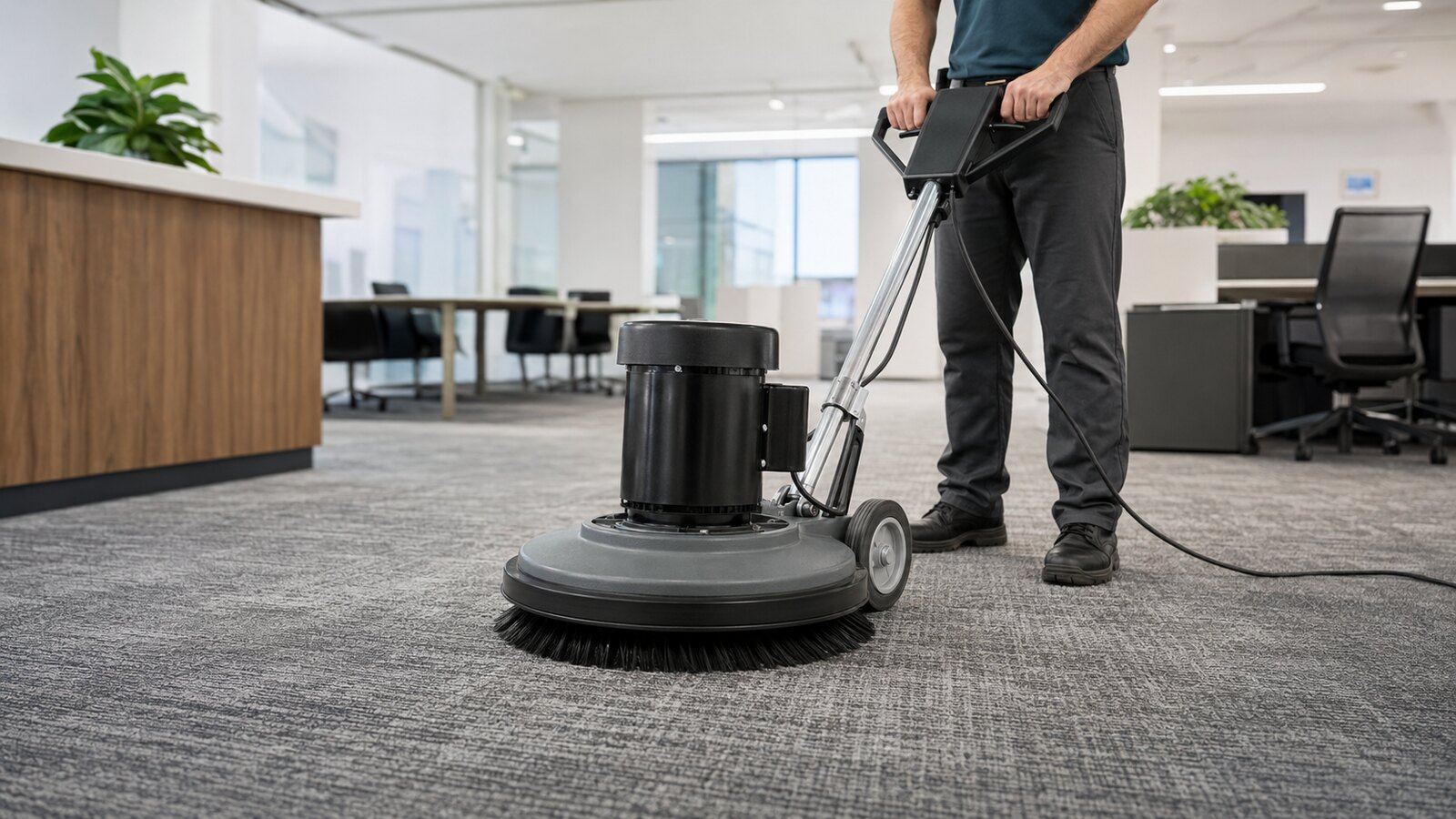
Commercial carpet cleaning should solve a facility problem, not simply put every square foot on the same cleaning schedule. The right plan depends on where soil is building up, how the property is used, how quickly areas must return to service, and whether the carpet is a good candidate for the cleaning method being proposed.
Our primary method is low-moisture encapsulation cleaning. It is commonly used as an interim or appearance-maintenance method for commercial carpet because it introduces relatively little moisture and can fit well into occupied facilities. We also think it is important to be clear about the boundary: encapsulation is not a universal substitute for restorative hot-water extraction or for the carpet manufacturer's own maintenance requirements.
If your carpet needs a method we do not provide, we would rather say that than force every condition into the same service.
Is Low-Moisture Commercial Carpet Cleaning a Good Fit?
Encapsulation tends to make the most sense when the goal is ongoing appearance maintenance on compatible commercial carpet and carpet tile, especially where long wet-cleaning windows would be difficult to accommodate.
| Property condition or need | What to consider |
|---|---|
| Routine soil and traffic lanes on maintained commercial carpet | Encapsulation may be a practical maintenance option. |
| Carpet tile or low-pile synthetic commercial carpet | Often a good candidate, subject to the carpet manufacturer's guidance and site condition. |
| Entrances and corridors soil faster than the rest of the property | A targeted high-traffic lane treatment may make more sense than cleaning everything at the same frequency. |
| Isolated spills or marks | Start with spot and stain treatment rather than assuming a full-property cleaning is needed. |
| Heavy, long-neglected, deeply impacted soil | A restorative method such as hot-water extraction may need to be considered. We do not offer hot-water extraction. |
| Carpet manufacturer specifies a particular maintenance process | Follow that guidance first, especially where warranty terms are involved. |
| Carpet is physically worn, delaminated, damaged, or permanently discolored | Cleaning may not correct a material-condition problem; repair or replacement may be the more useful discussion. |
The Carpet and Rug Institute's commercial maintenance standard, CRI 204, emphasizes a planned maintenance approach rather than one identical method or interval for every installation.
What We Look At Before Recommending a Scope
A commercial property rarely soils evenly. Entrances can receive outside soil, corridors concentrate foot traffic, break areas can collect food and beverage spots, and private rooms may need much less frequent attention. That is why the first useful question is not simply “How many square feet?”
We also want to understand:
- the carpet or carpet-tile construction, if known;
- the overall condition and cleaning history;
- where visible soil, spots, or traffic patterns are concentrated;
- which areas are occupied and when they can be taken out of service;
- access to floors, suites, elevators, loading areas, and parking;
- whether furniture or equipment limits access;
- any known manufacturer instructions or facility requirements; and
- whether the goal is one-time cleanup, appearance maintenance, or a recurring program.
These details help separate a simple cleaning request from a property that needs zoning, special spot work, a different method, or a phased schedule.
What a Typical Encapsulation Visit Includes
The exact sequence depends on the property and agreed scope, but a commercial encapsulation visit generally centers on soil removal, application of the cleaning chemistry, agitation, drying, and follow-up vacuuming as appropriate.
Pre-vacuuming matters because dry particulate soil is better removed before wet or low-moisture chemistry is introduced. The encapsulation solution is then worked through the carpet pile with the appropriate equipment for the installation. As the chemistry dries, soil and residue are left in a form intended to be removed through vacuuming.
A proposal should describe the actual areas included rather than relying on vague language such as “clean carpet.” For a multi-zone property, that may mean identifying lobbies, corridors, suites, conference rooms, common areas, guest areas, or other agreed spaces.
One-Time Cleaning vs. a Maintenance Program
A one-time service can make sense before an event, after unusual traffic, during a tenant transition, or when a property simply needs a reset. But commercial carpet usually benefits from planned maintenance by traffic level rather than waiting until every area looks equally dirty.
A recurring plan can use different frequencies for different zones. For example, an entrance or primary corridor may need attention more often than a low-traffic office. We do not publish a universal “monthly” or “quarterly” rule because the right cadence changes with occupancy, soil exposure, carpet type, vacuuming quality, seasonality, and appearance expectations.
See Recurring Maintenance Programs and How Often Should Commercial Carpet Be Cleaned? for the decision factors we use.
Encapsulation vs. Hot-Water Extraction
These methods solve overlapping but not identical problems.
Encapsulation uses a relatively low amount of moisture and is often used for routine interim maintenance. Hot-water extraction introduces and extracts substantially more solution and is commonly considered when deeper restorative cleaning is needed. Carpet manufacturers and professional standards may call for different processes based on the installation and condition.
We specialize in encapsulation and do not offer hot-water extraction. That makes it especially important for us to explain when another method may be worth considering. Our full encapsulation vs. hot-water extraction guide lays out the tradeoffs without pretending one method is universally better.
What Affects a Commercial Carpet Cleaning Quote?
We do not publish a one-size-fits-all price because commercial scopes vary widely. The factors that can change labor, setup, chemistry, and scheduling include:
- carpeted square footage and how it is divided across rooms or floors;
- open space versus furnished or partitioned areas;
- overall soil level and the amount of targeted spot work;
- high-traffic lanes that need additional attention;
- elevators, stairs, access windows, security procedures, and loading distance;
- whether service needs to be phased around employees, guests, residents, students, or customers;
- one-time versus recurring scope; and
- travel and coordination across multiple properties.
Our guide to commercial carpet cleaning cost factors explains how to compare quotes without relying on a headline price that may not match the actual property.
How to Prepare the Property
Preparation does not need to be complicated. The most useful steps are to identify problem areas, confirm access, and decide what can or cannot be moved.
Before service, let us know about sensitive areas, security requirements, restricted rooms, known spills, loose transitions, damaged carpet, and any furniture or equipment that should not be moved. Small movable items can be handled according to the agreed scope, while heavy furniture, workstations, fixtures, and equipment typically need to remain in place unless another arrangement is made in advance.
For offices and other occupied buildings, see After-Hours Carpet Cleaning for Businesses for a practical scheduling checklist.
Commercial Carpet Cleaning Across San Diego County
We currently advertise service in San Diego, Carlsbad, Oceanside, Vista, San Marcos, Escondido, and Chula Vista.
The city pages are intended to add useful local context, not to repeat this page with another city name. The cleaning decision itself still starts with the property, carpet, condition, access, and operating constraints.
Questions Worth Asking Any Commercial Carpet Cleaner
Before approving a proposal, ask what method is being recommended and why, what areas are included, what is excluded, how spots and high-traffic areas are handled, what site preparation is expected, what happens if the carpet is not a good candidate for the proposed method, and how drying and access will be managed.
You can use our guide to choosing a commercial carpet cleaning vendor as a comparison checklist.
Industry Guidance We Reference
Our site references the Carpet and Rug Institute's commercial maintenance guidance and ANSI/IICRC S100 when discussing professional carpet-cleaning practices. Referencing those standards does not mean we are claiming certification or endorsement. See our Service Standards page for that distinction.
If low-moisture encapsulation looks like a good fit for your property, request a quote with the carpeted square footage, property type, condition, and preferred cleaning window. We can use those details to define a real scope instead of guessing from square footage alone.