
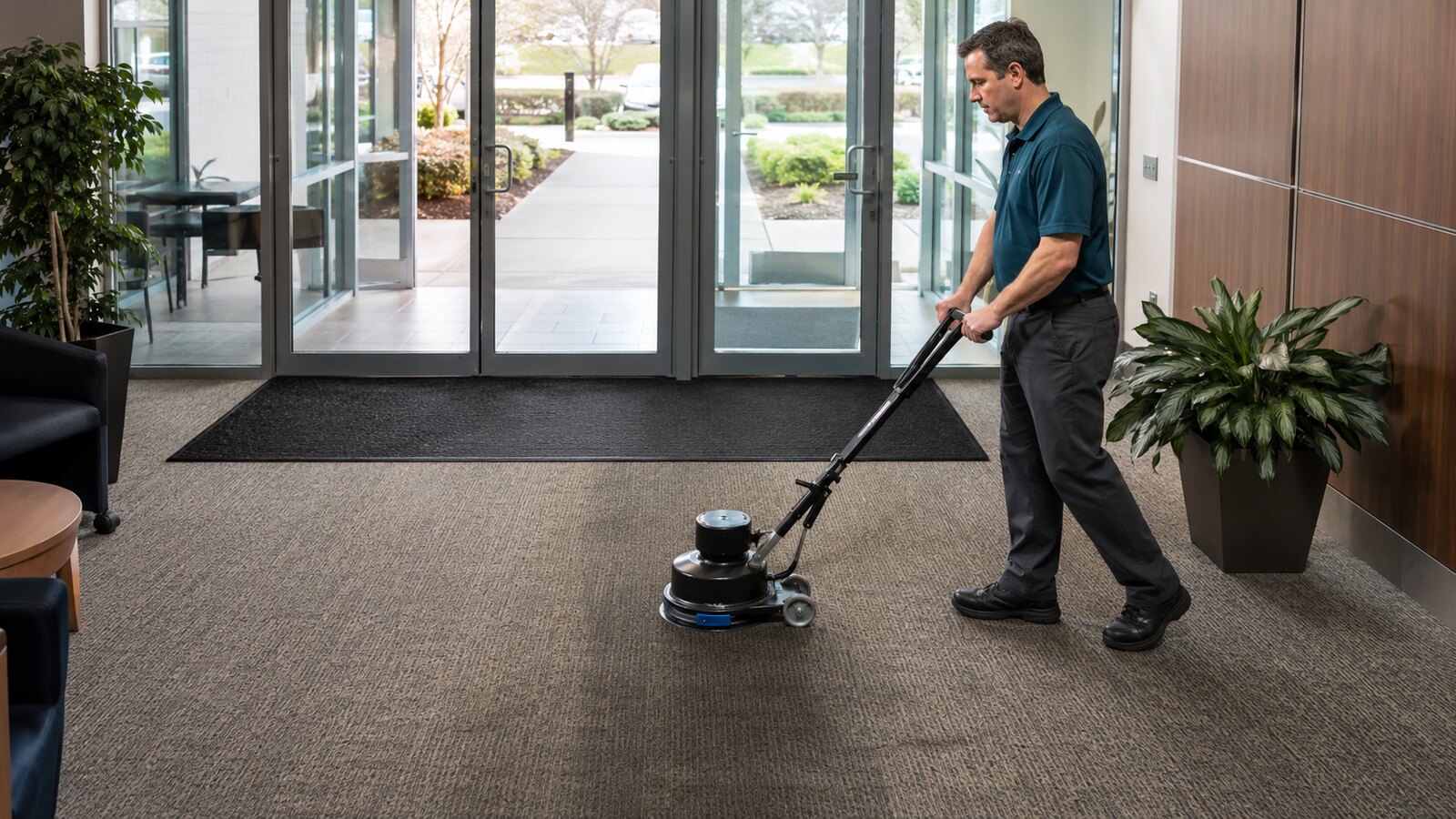
Commercial carpet rarely wears and soils at the same rate across an entire building. The main entrance may change appearance long before a private office. A corridor can look tired while adjacent rooms still look clean. Treating those differences as separate maintenance zones can be more useful than putting the whole property on one identical cycle.
High-traffic lane treatment is a focused low-moisture encapsulation service for those concentrated areas.
Where High-Traffic Lanes Usually Develop
Common examples include:
- building entrances and vestibule approaches;
- elevator lobbies and paths between elevators and suites;
- main office corridors;
- paths between reception, conference rooms, and work areas;
- hotel corridors and lobby routes;
- retail traffic paths and service counters;
- school or daycare circulation areas; and
- apartment or senior-living common-area walkways.
The key characteristic is not the room name. It is repeated traffic concentrated along the same path.
Soil vs. Wear: An Important Distinction
A dark-looking traffic lane is not automatically a cleaning problem.
Loose and oily soil can change carpet appearance and may respond to cleaning. But repeated traffic can also crush or abrade fibers, change texture, create permanent shading, or reveal wear that cleaning cannot reverse. Lighting direction can make pile distortion look darker as well.
Before promising an outcome, it is better to ask whether the difference is primarily soil, physical wear, or a combination of both. We do not guarantee that a worn lane will return to the appearance of low-traffic carpet simply because it is cleaned.
When Targeted Treatment Makes Sense
Targeted service can be useful when:
- the rest of the property still looks acceptable;
- entrances or corridors soil much faster than surrounding areas;
- a recurring full-property cleaning would be unnecessarily frequent;
- the facility wants to maintain client-facing or guest-facing paths between broader services; or
- seasonal conditions increase tracked-in soil at specific entrances.
If the entire carpeted area is uniformly soiled, commercial carpet cleaning may be the more logical scope.
A Better Way to Build Maintenance Frequency
Instead of starting with “monthly” or “quarterly,” divide the property into traffic zones and observe how quickly each one changes.
A simple facility map can mark:
- Very high traffic — main entries and primary circulation paths.
- Moderate traffic — shared rooms, secondary corridors, and common work areas.
- Lower traffic — private rooms or areas with limited daily use.
The Carpet and Rug Institute's CRI 204 commercial maintenance standard supports the broader principle of planned maintenance based on use and soil conditions. That makes zone-based scheduling more defensible than one arbitrary interval for every room.
What a Targeted Visit Can Include
The agreed scope may identify specific corridors, entries, elevator paths, or other lanes rather than entire floors. Those areas can receive vacuuming and low-moisture encapsulation treatment as appropriate for the carpet and condition.
If isolated spots are present within the lane, spot and stain treatment may also be relevant. If the lane is heavily impacted beyond routine maintenance, another method may need to be considered.
Entrances Need More Than Periodic Cleaning
Professional cleaning is only one part of entrance maintenance. Effective walk-off matting, regular vacuuming, prompt spot response, and control of tracked-in soil all affect how quickly the carpet behind an entrance becomes loaded.
A facility that ignores daily dry-soil control can make any periodic cleaning schedule work harder than it should. Our guide on preventing carpet wear in high-traffic areas covers the broader maintenance system.
When the Problem Is Physical Wear
If fibers are visibly worn, frayed, crushed beyond recovery, permanently discolored, or damaged at a transition, cleaning may improve soil but not restore the material. In carpet-tile installations, isolated replacement may sometimes be more practical. In broadloom installations, repair or replacement decisions can be more involved.
We want that distinction clear before a property spends money trying to “clean out” a wear pattern.
Pairing Lane Treatment With a Recurring Program
A recurring program can combine more frequent attention to high-traffic zones with less frequent full-area cleaning. The exact cadence should be adjusted after observing the property rather than copied from a generic schedule.
See Recurring Maintenance Programs and How Often Should Commercial Carpet Be Cleaned?.
What to Include in a Quote Request
Tell us which areas are changing appearance first, the approximate size or length of those lanes, the overall carpet condition, when the rest of the carpet was last professionally cleaned, and whether the goal is a one-time treatment or ongoing maintenance. Photos can help distinguish an isolated soil problem from broader wear before scheduling.
If the issue is concentrated in traffic lanes rather than the whole property, request a quote and identify those zones. We can discuss a targeted scope without automatically expanding the job to areas that do not need it.