
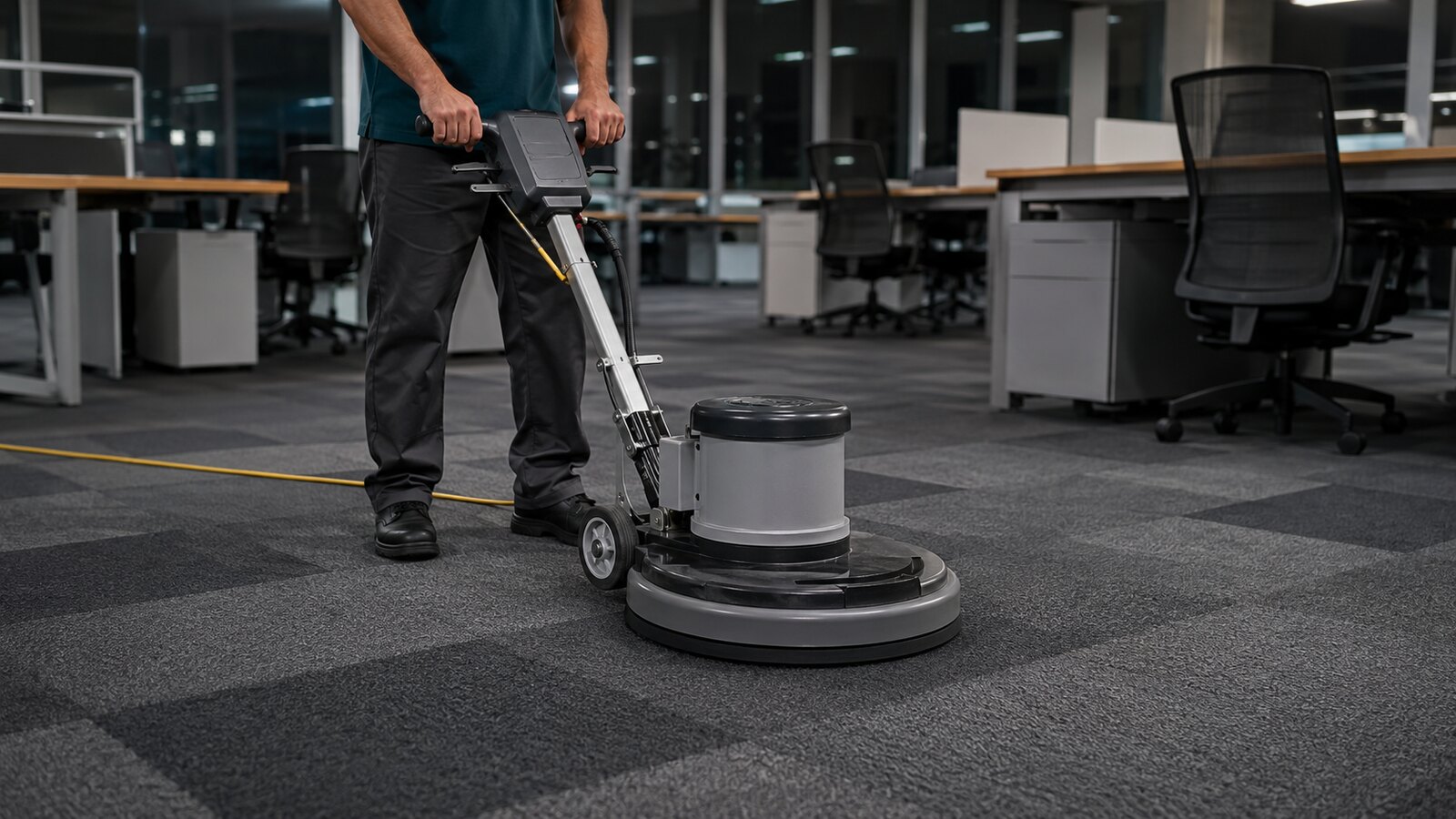
Carpet tile is designed differently from traditional broadloom carpet, and the cleaning plan should reflect that. Modular tiles create many seams, may use different backing or installation systems, and allow individual sections to be replaced when damage is isolated.
We use low-moisture encapsulation for compatible commercial carpet tile, but the important question is not simply “Is this carpet tile?” It is what product is installed, what condition is it in, and what problem are we trying to solve?
Why Carpet Tile Is Common in Commercial Buildings
Offices, retail spaces, shared building areas, and other commercial interiors often use carpet tile because damaged sections can sometimes be replaced without removing an entire room of carpet. Modular layouts can also make phased installation and future changes easier.
That modular construction changes the maintenance conversation. Cleaning should account for individual tile condition, seams, transitions, backing, and any loose or damaged pieces before equipment is run across the floor.
What We Inspect Before Cleaning
Before a carpet-tile scope is finalized, useful checks include:
- manufacturer and product line, if known;
- fiber and backing construction;
- whether tiles are glued, pressure-sensitive, or installed with another system;
- loose corners, lifted edges, bubbles, or damaged transitions;
- isolated tiles with permanent staining or physical damage;
- traffic lanes that look different from surrounding tiles;
- previous cleaning methods; and
- any manufacturer maintenance instructions available for the product.
If a tile is already loose or the backing is failing, cleaning should not be presented as a repair.
Low-Moisture Encapsulation on Carpet Tile
Encapsulation is a low-moisture process that can be useful for routine appearance maintenance on many commercial carpet-tile installations. The process applies cleaning chemistry, agitates the pile with suitable equipment, allows the carpet to dry, and relies on vacuuming to remove dried residue and soil.
The lower amount of introduced moisture can be operationally useful, but it does not eliminate the need to follow manufacturer instructions. Some carpet products specify chemistry, equipment, pH ranges, extraction intervals, or other maintenance requirements.
See Low-Moisture Encapsulation Carpet Cleaning for the full method explanation.
Seams, Edges, and Transitions
A room of carpet tile can contain hundreds of edges. Those seams can make tracked soil, alignment issues, or color variation more visible than on broadloom carpet.
Before cleaning, loose edges and damaged transitions should be identified. During maintenance, traffic lanes and edges can receive additional attention where needed, but aggressive treatment should not be used to hide an installation problem.
Cleaning vs. Replacing an Individual Tile
One of the biggest advantages of a modular system is that replacement may be an option for localized damage.
Cleaning is usually worth considering when the problem is soil, an ordinary spot, or a traffic pattern. Replacement may be the more rational choice when a tile is torn, permanently discolored, badly crushed, delaminated, or otherwise physically damaged and compatible replacement stock is available.
Before replacing a tile, property teams should consider dye-lot or age-related appearance differences. A brand-new tile can sometimes look different next to older material even when it is technically the same product.
Traffic Lanes on Modular Carpet
Carpet tile still develops the same basic traffic patterns as other commercial carpet: entrances, main walk paths, elevator approaches, and heavily used common areas can change appearance faster than low-traffic zones.
Rather than cleaning every tile at the same frequency, a maintenance plan can use high-traffic lane treatment between broader services where the installation and condition support it.
Carpet Tile vs. Broadloom
The cleaning chemistry may overlap, but the installation details differ. Broadloom has fewer seams across a room but can have stretched or glued installations, while carpet tile has many modular edges and makes localized replacement more feasible.
Our Carpet Tile vs. Broadloom Cleaning guide compares the maintenance decisions side by side.
What Cleaning Cannot Fix
Commercial carpet cleaning can address soil and some spots, but it cannot reverse:
- worn or missing fiber;
- delamination or backing failure;
- permanently bleached or chemically altered color;
- loose installation caused by adhesive or substrate problems;
- cuts, burns, tears, or other physical damage; or
- a tile that no longer matches because of age, fading, or replacement stock differences.
Identifying those limitations before service prevents repeated cleaning attempts on a problem that is not actually a cleaning problem.
What to Include in a Carpet-Tile Quote Request
If possible, tell us the approximate carpeted square footage, building or room type, whether you know the carpet manufacturer, the main traffic zones, any loose or damaged tiles, and whether the issue is general appearance or isolated staining. Photos are particularly useful for modular carpet because they can show seam, edge, and replacement issues before scheduling.
The Carpet and Rug Institute's commercial maintenance guidance is a useful general reference, while the installed carpet manufacturer's instructions should control where they are more specific.
If your commercial carpet tile appears suitable for low-moisture maintenance, request a quote and include the product or installation information you have. We can define the cleaning scope separately from any tiles that may be better repaired or replaced.