
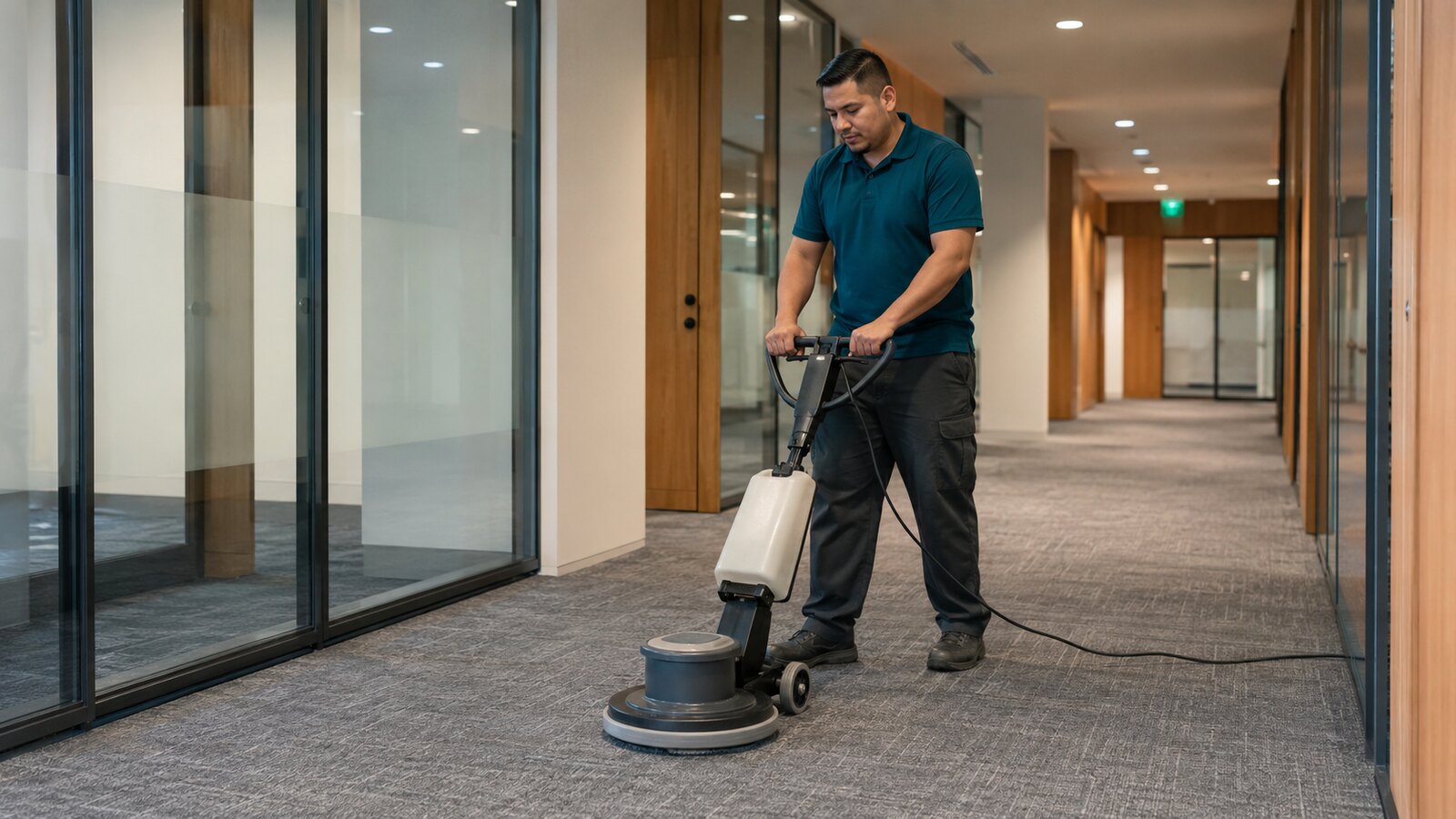
Low-moisture encapsulation is the commercial carpet-cleaning method we specialize in. It is especially useful as part of a planned maintenance program where the property needs carpet to look consistently maintained without introducing the amount of moisture associated with a restorative extraction process.
The important part is not the label on the method. It is whether the method matches the carpet construction, soil condition, facility schedule, and maintenance goal.
How Encapsulation Works
Encapsulation systems use cleaning chemistry designed to loosen soil from the carpet fiber and leave remaining soil and chemistry in a dry residue that can be removed by vacuuming after the carpet dries. Depending on the system and installation, the solution may be applied with a sprayer and agitated with a suitable machine, or applied through equipment designed to distribute and work the chemistry through the pile.
The process does not depend on flooding or rinsing the carpet with large quantities of water. That is the main reason encapsulation is categorized as a low-moisture method.
A typical service can include:
- confirming the agreed cleaning zones and identifying problem areas;
- removing dry soil through vacuuming where included in the scope;
- applying the appropriate encapsulation chemistry;
- mechanically agitating the carpet with equipment suited to the installation;
- allowing the carpet to dry under the property's normal or improved airflow conditions; and
- vacuuming dried residue as appropriate to the system and maintenance plan.
The exact sequence should always be adjusted to the carpet, chemistry, and site rather than treated as a rigid recipe for every building.
Where Low-Moisture Encapsulation Fits Best
Encapsulation is often a strong candidate for commercial properties with low-pile synthetic carpet or carpet tile that receive regular maintenance. Offices, hotels, property-managed buildings, retail spaces, and other occupied facilities can benefit from a process that is easier to schedule around normal operations than a heavily wet restorative cleaning.
It can be particularly useful for:
- recurring appearance maintenance;
- traffic lanes that soil faster than surrounding areas;
- commercial carpet tile and compatible broadloom installations;
- properties that need cleaning divided into phases or zones; and
- facilities where limiting the wet-cleaning window is operationally important.
For a broader service overview, see Commercial Carpet Cleaning.
Where Encapsulation May Not Be Enough
A low-moisture method should not be sold as the answer to every problem.
If carpet has been neglected for a long period, is heavily impacted with soil, has contamination concerns outside normal carpet maintenance, or needs deeper restorative cleaning, hot-water extraction or another specialist process may be more appropriate. The same is true when the carpet manufacturer specifically requires a different process at certain intervals.
Physical damage is another boundary. Cleaning does not repair worn fiber, delamination, damaged backing, loose seams, permanent discoloration, or failing adhesive. With carpet tile, isolated replacement can sometimes be more practical than repeatedly treating a damaged tile.
Our encapsulation vs. hot-water extraction comparison explains these tradeoffs directly. We do not offer hot-water extraction, so there is no benefit to us in pretending the two methods are interchangeable.
Encapsulation and Carpet Tile
Commercial carpet tile is a common use case for low-moisture cleaning because the installations are often low-pile and designed for heavy commercial use. But “carpet tile” is not one universal material. Backings, fibers, adhesives, installation systems, and manufacturer care instructions differ.
Before choosing a process, it is useful to know the carpet manufacturer and product line when that information is available. That can help confirm compatible chemistry and maintenance procedures. Our Carpet Tile Cleaning page focuses on those installation-specific decisions.
Drying Time: Why We Avoid One Universal Promise
Low-moisture encapsulation generally has a shorter wet period than hot-water extraction because less liquid is introduced into the carpet. That does not mean every building has the same drying time.
Drying is affected by:
- carpet density and construction;
- how much solution the condition requires;
- indoor temperature and relative humidity;
- air movement and HVAC operation;
- room size and ventilation; and
- whether the area is cleaned all at once or in zones.
For an occupied property, the better planning question is: When does this area need to be safely and practically back in normal use? We can use that operating window when discussing scope and scheduling instead of promising a fixed number that may not fit the site.
Why Vacuuming and Dry-Soil Control Matter
Commercial carpet can hold a large amount of dry particulate soil. Cleaning chemistry should not substitute for routine vacuuming. Removing loose dry soil before it is mixed with moisture is a basic part of a sound maintenance program, and ongoing vacuuming remains important after professional cleaning.
The Carpet and Rug Institute's commercial cleaning and maintenance guidance emphasizes planned maintenance rather than relying on periodic wet cleaning alone.
How Encapsulation Fits Into a Maintenance Program
The best schedule is rarely “clean everything every X months.” Different zones soil at different rates.
A facility may use more frequent high-traffic lane treatment at entrances and main corridors, less frequent full-area encapsulation in low-traffic spaces, and periodic assessment for whether a restorative extraction process is needed. That approach matches maintenance to actual use instead of making every square foot follow the same calendar.
See Recurring Maintenance Programs and our guide to how often commercial carpet should be cleaned for a practical framework.
What Industry Standards Actually Say
The Carpet and Rug Institute publishes CRI 204, a commercial carpet maintenance standard. ANSI/IICRC S100 also addresses professional cleaning of textile floor coverings. These sources support the idea of method selection, inspection, manufacturer guidance, and planned maintenance; they do not establish that one cleaning method is universally correct.
We reference these standards as guidance. We do not use the references as a claim that our company is certified or endorsed by CRI or IICRC. See Service Standards for the distinction.
Questions to Ask Before Choosing Encapsulation
Before approving low-moisture cleaning, it is reasonable to ask:
- What is the carpet manufacturer and what maintenance does it recommend?
- Is the goal appearance maintenance or restorative soil removal?
- Are the problem areas isolated or property-wide?
- Is there physical damage that cleaning cannot correct?
- When must the area return to use?
- What vacuuming and interim maintenance happens between professional visits?
- Is another method needed periodically even if encapsulation is used routinely?
Those questions lead to a more useful scope than choosing a method solely because it sounds fast or convenient.
If you want to know whether encapsulation fits your property, request a quote and include the carpeted square footage, property type, current condition, known problem areas, and preferred service window. If another method appears more appropriate, we will say so.